Friday, April 8, 2016

Unit 4: Money 3/10/9

The Federal Reserve is the personal bank of the government and is the central bank of the Unite States. It controls money supply, the reserve requirement, and member and distric banks.
 The Federal Reserve is the entity that controls monetary policy. They have 4 tools to work with

  1. Open Market Operations (buying and selling of bonds)
  2. Discount Rate (the interest rate that the Fed charges banks)
  3. Reserve Requirement
  4. Federal Fund Rate (the rate banks charge other banks for short term loans.
The Fed can employ two policies when using these tools, expansionary to fight a recession, or contractionary to fight inflation.

Under Expansionary Policies, The Fed wants to increase Money Supply, which will increase Ad and decrease interest rate,
To do so, they could 
  • Buy bonds
  • Lower Reserve, Discount, and Federal Funds Rate
Under Contractionary policy, The Fed want to decrease Money Supply, which will decrease AD and increase interest rates
To do so, they could
  • Sell bonds
  • Increase Reserve, Discount, and Federal Funds Rate.

Fiscal Policy Vs. Monetary Policy
The government is responsible for Fiscal Policy and the Fed is responsible for Monetary Policy

Expansionary Monetary Policy increases money supply which increase AD and lowers interest rate

Contractionary does the opposite

Expansionary FISCAL Policy increases AD through increasing Government Spending and lowering taxes, this creates a deficit and increases the interest rate. This also lower exports and import because this causes the dollar to appreciate 

Contractionary does the opposite
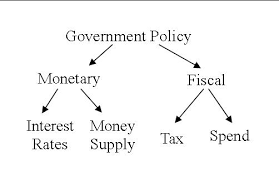
Image result for federal reserve monetary policy  vs fiscal policy

Unit 4: Money 3/9/16

The future value of money through interest can be determined through two formulas depending on the way the interest is calculated.

v = future value of money     r = real interest rate    n  = inflation rate     p = present value or principal
n = # of years        k  =   interest credited per year (# of times interest is given per year, etc.)

The yearly interest rate formula  that is not compounded is       v = ((1 + r) ^ n ) * 9

The compounded interest rate formula is                                    v = ((1 + r/k) ^n * k) * 9


Demand for money and its effects on AD

The demand for money has an inverse relationship with nominal interest rates and the quantity of money demanded

As the quantity of money demanded goes down, interest rates go up.
As the quantity of money demanded goes up, interest rates go down

The demand of money shifts with changes in taxes, income and price level, or anything that changes investment prospects.

The supply of money affects AD

As money supply goes up, Interest rates goes down, which increases Investment and increases AD
As money supply goes down, Interest rates goes up, which decreases Investment and decreases AD

Financial Sector

Assets are what people and institutions own, and liabilities are what they owe. If a person took a loan out, the loan would be an assets to the bank and a liability to the person.

Banks are financial intermediaries that use liquid assets and sell services to run as a business.

Most  banks today use a fractional reserve system, where banks are required to hold a fraction of their reserves. the rest the banks are able to loan out to people.

Banks and the Creation of Money

Banks create money by lending deposits that people place in banks. Potential loans are measured by T-charts or a balance sheet.
On the banks liabilities side of the T chart are Demand Deposits and Owner's Equity.
On the banks assets side of the T chart are Required reserves and Excess Reserves, Property, Securities and bonds, and Loans.

Reserve Requirement
The Fed requires banks to always have some money readily available to meet consumers’ demand for cash.
The amount , set by the Fed, is the Required Reserve Ratio or RRR.
The Required Reserve Ratio is the % of demand deposits that cannot be loaned out

To find out the amount of money that is created by loans in the entire banking system use the formula:
Amount of Money Created = ER * 1/RRR
ER * 1/RRR is also known as the money multiplier.

The money is created by this multiplier through Multiple Deposit Expansion where one person takes their loan and places it in another bank and that bank loans his deposit out, and so on and so on

Usually, the money created is less than what is calculated because sometimes banks can hold excess reserves instead of loaning it out or people might not deposit their loan


Unit 4: Money 3/7/16

Money has three uses:

  • A medium of exchange used for trade and barter
  • A unit of account or the economic worth in the exchange process
  • a store of value that people can hold to keep value over time
There are also three types of money 
  1. Commodity money: the value of the money is determined by the material of the currency: gold and silver coins. This type of money is limited.
  2. Representative money: this type of money represents a tangible good that has value, like dollars that can be exchanged for gold. This type is limited and usually more portable
  3. Fiat money: This type of money holds value solely because the government "says so" . This type of money is unlimited and portable.
Money also has six characteristics
  1. Easy to carry
  2.  durable
  3. Scarce
  4. Divisible
  5. Acceptable 
  6. Uniform
The Money Supply is split into the levels of liquidity or how easy it is to turn into cash; M1, M2, and M3. M1 is the most liquid and includes all currency in circulation, traveler's check, and checkable and demand deposits. M2 is less liquid than M1 and includes M1 + Savings accounts. M3 is the least liquid and includes M2 + certificates of deposits. 

Sunday, March 27, 2016

Unit 4 - Monetary Policy Video Summaries

Video 1:
There are three types of money; Commodity money, Representative money, and Fiat money. Commodity money would be using the values of goods, such as food or animals. This type is not very portable or divisible. Representative money is currency that can be exchanged for something of value such as gold. This money is finite however since most things of value are finite. Fiat is money that is only backed up by word of the government and is not really backed by anything valuable, but is infinite. Money has 3 functions: medium of exchange(use it to buy stuff), store of value,(save it), and a unit of account(use it to judge others).

Video 2:
Money Market graphs has interest rate(price of money) on the y axis and quantity of money on the x axis. The Demand of money line slopes downward due to the Law of Demand, as price increases, demand decreases. Supply of money is vertical because it is fixed and set by the Fed. Fed adjusts money supply to stabilize interest rates to promote economic growth

Video 3:
The Fed has three tools of Monetary Policies; Reserve rate(amount of money banks are required to keep), Discount rate(amount of interest charges to banks for loaning from other banks), and Open Market Operations(The selling and buying of securities) There are two ways to use these tools; in an Expansionary(easy money) or Contractionary(tight money) way. In order to follow the expansionary route, the fed could lower Reserve and Discount rates to free more money and buy securities to inject money into circulation. Vice Versa, the fed, if it wanted to follow a more contractionary policy, it would raise Reserve and Discount rates and sell securities to take money out of circulation.

Video 4:
The Loan-able Funds graphs has interest rate(price of money) on the y axis and quantity of loan-able funds (money) on the x axis like on the money market graph. Demand of loan-able funds slopes down still to the Law of Demand and Supply slopes upward. Supply is dependent on savings and is positive since banks turn savings into loans. Loan-able funds and the money market are closely related by interest rate. A change in interest rate in one graph will affect the other.

Video 5:
Money is created by making loans through the money multiplier and multiple deposit expansion. The money multiplier is 1/RR or reserve ratio. Multiple deposit expansion is what happens when loans get deposited then turned into loans again. This is assuming that there are NO excess reserves. the amount generated is the amount of loans times the money multiplier

Video 6:
Money Market and loan-able funds are also connected to AS and AD. Since MV = PQ, (Money Supply * Velocity of money being spent = Price * Quantity) when interest rates go up, so do prices. If Demand of loanable fund and money supply increases, it increases aggregate demand since both interest rate and price level have to increase. Interest rates are proportional to Price levels. This is called the Fisher Effect.


http://www.youtube.com/watch?v=YLsrkvHo_HA&feature=results_video&playnext=1&list=PL2CB281D126F65E26

http://www.youtube.com/watch?v=gzFdeM6lUno&feature=bf_prev&list=PL2CB281D126F65E26&lf=results_video

http://www.youtube.com/watch?v=XJFrPI8lLzQ&feature=bf_next&list=PL2CB281D126F65E26&lf=results_video

http://www.youtube.com/watch?v=rdM44CC0ELY&feature=bf_next&list=PL2CB281D126F65E26&lf=results_video

http://www.youtube.com/watch?v=1tUC59pz95I&feature=bf_next&list=PL2CB281D126F65E26&lf=results_video

http://www.youtube.com/watch?v=k37Y6BKcpsY&feature=bf_next&list=PL2CB281D126F65E26&lf=results_video


If the links don't work, try typing the URLs manually.

Enjoy! :D


Friday, March 4, 2016

UNIT 3: Aggregate Demand & Supply 2/25/16

Disposable Income is income that is left over after Taxes and Bills, Net income
Gross Income - Taxes = DI

There are only two options when deciding how to use DI: Consuming it or spending it.
if DI increases, both savings and consumptions increase
If DI = 0 then auto consumption has left no income for savings, or it has even dipped into dis-savings

Average Propensity to Consume is the average willingness to spend money
Average Propensity to Save is the average willingness to save money

Average Propensity to Consume + Average Propensity to Save ALWAYS = 1 since DI = 1
if APC > 1, or you have a negative APS = dis-savings
1 - APC = APS
1 - APS = APC

Marginal Propensity to Consume is the fractions of change that occurs to consumption when DI changes.

Marginal Propensity to Save is the fractions of change that occurs to Savings when DI changes.

Change in Consumption        =    MPC
Change in DI

Change in Savings        =    MPS
Change in DI

Like APC and APS, MPS + MPC = 1

Spending Mulitpliers

The formula to find Government Spending Multiplier is 1/MPS or 1/(1-MPC)

The formula to find Tax Multiplier is negative MPC/MPS

The Paradox of Thrift claims that people save in a recession, which worsens the condition of the recession.

If consumption is 1:1 with DI, there is a upwards sloping 45 degree function where C = DI and there is no Savings

2/29/16

Deficit budget means that we spend more than we take in   Revenue<Expenditures
Surplus Budget means that we earn more than we spend     Revenue>Expenditures
Balanced Budget means that we break even                         Revenue=Expenditures

If a government is in a deficit, it primarily borrows money to pay it back
It can borrow money from citizens and corporations in the form of taxes and bonds, or it can borrow money from foreign governments.

Fiscal Policies include 2 things; Discretionary(action must be taken) and Non Discretionary(no action needed) policies

The government has two options to discretionary actions it can control to help regulate the economy: Change Taxes or Change Government Spending

Easy money is used to combat recessions and involves lessening taxes and increasing government spending

Tight money is used to combat inflation and involves raising taxes and increasing government spending

Non discretionary policies would include Automatic Stabilizers; Such as Social Security, Welfare, government transfer payments, Medicare and Medicaid


UNIT 3: Aggregate Demand & Supply 2/23/16

Investment Demand is the demand for new factories, machinery , technology, new homes, inventory.

Expected Rate of Return determines how much people invest; The higher the expected rate of return the more people will be willing to invest in businesses.
Interest Rates > Expected Rate of Return =  No or less interest
Interest Rates < Expected Rate of Return =  More interest

Real(r% or interest cost) vs Nominal Interest(i%)
r% = i% - pi(inflation rate)

Interest Demand Curve is sloping downward;
As interest rate goes up, Loans supplied decreases
And as Interest rates goes down, Loans supplied increase.

Lower costs and Lower Business Taxes push the curve to the right
Positive changes in technology also pushes ID curve to the right
More Stock Capital in the economy increases the curve to the right
Expectations Positive moves it right and Negative moves it left.

2/24/16

Classical Vs Keynesian Economic Schools of Thought  

Classical includes thoughts such as:

  • Competition is good
  • "invisible hand" or self regulation of the economy
  • the economy is at balance at Full Employment 
  • "Trickle down" effect
  • Strengthening the rich so they can strengthen the poor 
  • Modern followers include: Adam Smith, J.B. Say, Alfred Marshall, David Ricardo
  • Say's Law: Supply creates Demand 
  • Under-spending is Unlikely
  • Production = income = spending
  • investment = savings
  • Prices and Wages are flexible downward 
  • Unemployment is negated by price/wage flexibility but can be cause by external sources
  • Inflation is caused by too much money
  • Basic Equation is MV = PQ
Keynesian includes thoughts such as:

  • Competition is flawed
  • Aggregate Demand creates Supply not vice versa
  • Leaks in the circulation or savings cause recessions
  • Ratchet effect causes sticky wages
  • Recession's block Say's Law
  • In the long run "We are all dead"
  • Modern Followers include: J.M. Keynes
  • Depressions refute Say's Law
  • Under-spending persists.
  • Saving does not equal Interest since people save/invest for different reasons
  • Lending boost money supply
  • Prices and wages are inflexible downward due to the Ratchet effect
  • Basic Equation is  C + Ig + Xn + G
  • Inflation is caused by too much demand
  • Government should use fiscal policy to regulate economy 
  • Economy is not self regulating, no "invisible hand" 

UNIT 3: Aggregate Supply 2/19/16

Aggregate Supply is the Level of GDP that an economy will produce at the price level.
There are 2 types of Aggregate Supply, Long Run AS and Short Run AS.
In the Long Run:

  • Input prices are flexible and adjusted to price changes 
  • Real GDP is independent of price level
  • Represents a level of "Full Employment"
  • Analogous to PPC 
  • Vertical due to flexible prices
In the Short Run:
  • Input prices are sticky and do not adjust to price level
  • Real GDP is directly related to Price Level.
SRAS is pretty much how much it costs to produce one unit of product.
Total output               =      Level of productivity 
Total input 

Total output               =      Cost of Production per unit
Total input PRICE
 
2/22/16

Input prices include wages(75%), Cost of Capital (factories and tools), Raw Material and foriegn resource prices.

SRAS shifts depending on 3 factors that affect production; Productivity, Legal Institution Environments (Taxes/subsidiaries), Government Regulations.

"Full Employment" (unemployment at around 4-5%) lies where SRAS LRAS and AD intersect

Recessionary Gap: Equilibrium below FE Level
Inflationary Gap: Equilibrium occurs beyond FE Level

3 ranges of SRAS: Keynesian Range, Classical Range, and an Intermediate Range (goes more in depth later) 

Nominal Wages - Total amount of money received before deductions (Taxes, Bill, etc)
Real Wages - Net wages or amount of buying power the wages have after deductions 
Sticky Wages - Nominal wages set to a specific price level due to things like work contracts etc.